
ISS Alert
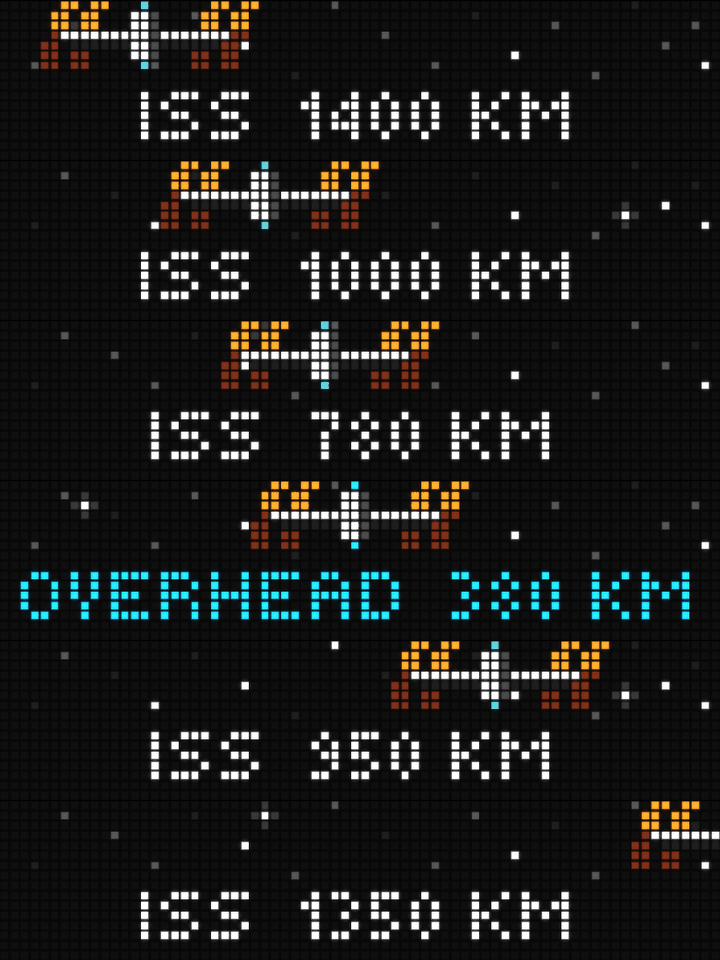
Stays quiet until the space station passes near you. Then a pseudo 3D ISS slides across a twinkling starfield, hangs overhead with live distance, and drifts off the far edge as it leaves.
How to run
This app is a single Python file that talks directly to the BUSY Bar HTTP API: no libraries, no setup. Connect your bar via USB and run:
python app.py
Over USB the bar is always at 10.0.4.20. On Wi-Fi, pass the bar's IP
with --host <address>.
No bar at hand? Run the
BUSY Bar Emulator
and point the app at it: python app.py --host 127.0.0.1:8080.
To keep it running without a terminal open, install it with busybar-manager, which handles the virtualenv, autostart and scheduling, and lets you switch between apps from a web dashboard.
Source code
#!/usr/bin/env python3
"""ISS alert: stays quiet until the space station passes near you, then counts it down.

    python3 app.py [--host 127.0.0.1:8080] [--lat 52.37] [--lon 4.89] [--test]
"""
import argparse
import json
import math
import sys
import time
import urllib.error
import urllib.parse
import urllib.request

APP = "iss-alert"
ISS_URL = "https://api.wheretheiss.at/v1/satellites/25544"

# State thresholds (km)
FAR       = 1500
NEAR      = 700


def parse_args():
    p = argparse.ArgumentParser(description="ISS alert for BUSY Bar")
    p.add_argument("--host", default="10.0.4.20")
    p.add_argument("--lat", type=float, default=52.37)
    p.add_argument("--lon", type=float, default=4.89)
    p.add_argument("--interval", type=int, default=30, help="seconds between position checks (default: 30)")
    p.add_argument("--test", action="store_true")
    return p.parse_args()


# ---------------------------------------------------------------------------
# HTTP helpers
# ---------------------------------------------------------------------------

def _base(host):
    host = host.replace("http://", "").replace("https://", "").rstrip("/")
    return "http://" + host


def _draw(host, elements, led_notification_color=None):
    """POST /api/display/draw. Returns (status_code, body_text)."""
    body = {
        "application_name": APP,
        "priority": 60,
        "elements": elements,
    }
    if led_notification_color is not None:
        body["led_notification_color"] = led_notification_color
    data = json.dumps(body).encode("utf-8")
    req = urllib.request.Request(
        _base(host) + "/api/display/draw",
        data=data,
        method="POST",
        headers={"Content-Type": "application/json"},
    )
    try:
        with urllib.request.urlopen(req, timeout=8) as r:
            return r.getcode(), r.read().decode("utf-8", "ignore")
    except urllib.error.HTTPError as e:
        return e.code, e.read().decode("utf-8", "ignore")
    except urllib.error.URLError as e:
        raise RuntimeError(f"draw failed: {e}") from e


def _clear(host):
    """DELETE /api/display/draw?application_name=..."""
    qs = urllib.parse.urlencode({"application_name": APP})
    req = urllib.request.Request(
        _base(host) + "/api/display/draw?" + qs,
        method="DELETE",
    )
    try:
        with urllib.request.urlopen(req, timeout=8) as r:
            return r.getcode()
    except urllib.error.HTTPError as e:
        return e.code
    except urllib.error.URLError as e:
        raise RuntimeError(f"clear failed: {e}") from e


def _fetch_iss():
    """Fetch ISS position from wheretheiss.at. Returns dict with latitude, longitude, altitude, velocity."""
    req = urllib.request.Request(ISS_URL, headers={"User-Agent": "busybar-iss-alert/1.0"})
    with urllib.request.urlopen(req, timeout=10) as r:
        return json.loads(r.read().decode("utf-8", "ignore"))


# ---------------------------------------------------------------------------
# Haversine distance
# ---------------------------------------------------------------------------

def _haversine(lat1, lon1, lat2, lon2):
    """Great-circle distance in km between two (lat, lon) points."""
    R = 6371.0
    phi1, phi2 = math.radians(lat1), math.radians(lat2)
    dphi = math.radians(lat2 - lat1)
    dlam = math.radians(lon2 - lon1)
    a = math.sin(dphi / 2) ** 2 + math.cos(phi1) * math.cos(phi2) * math.sin(dlam / 2) ** 2
    return R * 2 * math.asin(math.sqrt(a))


# ---------------------------------------------------------------------------
# Display elements
# ---------------------------------------------------------------------------

def _rect(el_id, x, y, w, h, color):
    return {"id": str(el_id), "type": "rectangle", "x": x, "y": y, "width": w, "height": h,
            "border_width": 0, "fill": "solid", "fill_colors": [color]}


# Starfield in the sky band (rows 0-7): (x, y, tier) with tier 0 = bright,
# 1 = mid, 2 = dim. Stars twinkle one tier brighter in turn on each redraw,
# and a plus-shaped glint wanders between a few fixed spots.
STARS = [(3, 6, 2), (6, 1, 1), (11, 3, 2), (15, 6, 1), (19, 1, 2), (24, 4, 0),
         (29, 7, 2), (33, 0, 1), (38, 3, 2), (43, 6, 1), (47, 1, 2), (51, 5, 0),
         (55, 2, 2), (59, 7, 1), (63, 0, 2), (66, 4, 1), (69, 2, 2), (70, 6, 0)]
STAR_COLORS = ["#FFFFFFFF", "#969696FF", "#505050FF"]
GLINTS = [(8, 2), (62, 5), (26, 1), (55, 3)]


def _starfield(tick=0):
    els = []
    for i, (x, y, tier) in enumerate(STARS):
        t = max(0, tier - (1 if (i + tick) % 4 == 0 else 0))
        els.append(_rect(f"star{i}", x, y, 1, 1, STAR_COLORS[t]))
    gx, gy = GLINTS[tick % len(GLINTS)]
    els.append(_rect("glint_h", gx - 1, gy, 3, 1, "#787878FF"))
    els.append(_rect("glint_v", gx, gy - 1, 1, 3, "#787878FF"))
    els.append(_rect("glint_c", gx, gy, 1, 1, "#FFFFFFFF"))
    return els


def _iss_sprite(x0):
    """Pseudo-3D ISS, ~22x7 at offset x0: four slanted solar arrays with a
    lit top and shaded bottom half, a truss with a drop shadow, and a module
    stack with a lit side, a shadow side and cyan docking ports."""
    light = "#FFC832FF"
    dark  = "#B46400FF"
    white = "#FFFFFFFF"
    gray  = "#8C8C8CFF"
    cyan  = "#00E5FFFF"
    els = []
    for px in (0, 3, 15, 18):
        for r in range(7):
            off = (6 - r) // 3   # rows shift right toward the top: slanted panels
            els.append(_rect(f"panel_{px}_{r}", x0 + px + off, r, 2, 1, light if r < 3 else dark))
    els.append(_rect("truss", x0 + 2, 3, 17, 1, white))       # truss
    els.append(_rect("truss_shadow", x0 + 3, 4, 15, 1, "#505050FF"))  # truss drop shadow
    els.append(_rect("module_lit", x0 + 9, 1, 2, 5, white))        # module stack, lit side
    els.append(_rect("module_shadow", x0 + 11, 1, 1, 5, gray))        # module stack, shadow side
    els.append(_rect("dock_top", x0 + 10, 0, 1, 1, cyan))        # docking port top
    els.append(_rect("dock_bottom", x0 + 10, 6, 1, 1, cyan))        # docking port bottom
    return els


def _iss_x(distance):
    """Slide the sprite toward the center as the ISS approaches:
    1500 km = far left, 700 km or less = centered."""
    frac = max(0.0, min(1.0, (FAR - distance) / float(FAR - NEAR)))
    return int(2 + frac * (25 - 2))


def _iss_x_depart(distance):
    """Continue from the center off the right edge as the ISS recedes:
    700 km = centered, 1500 km = fully off screen."""
    frac = max(0.0, min(1.0, (distance - NEAR) / float(FAR - NEAR)))
    return int(25 + frac * (72 - 25))


def _build_approach(distance, tick=0):
    """Approach: twinkling starfield, ISS sliding in from the left, one info line."""
    elements = _starfield(tick)
    elements += _iss_sprite(_iss_x(distance))
    elements.append({
        "id": "info_text",
        "type": "text", "text": f"ISS  {int(distance)} KM",
        "x": 36, "y": 9, "font": "small",
        "color": "#FFFFFFFF", "align": "top_mid",
    })
    return elements


def _build_depart(distance, tick=0):
    """Departing: the ISS slides on toward the right edge and off the screen."""
    elements = _starfield(tick)
    elements += _iss_sprite(_iss_x_depart(distance))
    elements.append({
        "id": "info_text",
        "type": "text", "text": f"ISS  {int(distance)} KM",
        "x": 36, "y": 9, "font": "small",
        "color": "#FFFFFFFF", "align": "top_mid",
    })
    return elements


def _build_overhead(distance, velocity, tick=0):
    """Overhead: twinkling starfield, ISS centered, bright cyan info line."""
    elements = _starfield(tick)
    elements += _iss_sprite(25)
    elements.append({
        "id": "info_text",
        "type": "text", "text": f"OVERHEAD  {int(distance)} KM",
        "x": 36, "y": 9, "font": "small",
        "color": "#00E5FFFF", "align": "top_mid",
    })
    return elements


# ---------------------------------------------------------------------------
# State classification
# ---------------------------------------------------------------------------

STATE_FAR      = "far"
STATE_APPROACH = "approach"
STATE_OVERHEAD = "overhead"
STATE_DEPART   = "departing"


def _classify(distance, prev_distance):
    """Determine display state from distance and whether it is shrinking."""
    if distance <= NEAR:
        return STATE_OVERHEAD
    if distance <= FAR:
        if prev_distance is None or distance < prev_distance:
            return STATE_APPROACH
        return STATE_DEPART
    return STATE_FAR


# ---------------------------------------------------------------------------
# Test mode
# ---------------------------------------------------------------------------

def _run_test(host):
    """Simulate a pass with fake distances and the real draw logic."""
    fake_distances = [1800, 1400, 1100, 850, 600, 400, 650, 900, 1600]
    fake_velocity  = 27600.0  # km/h, representative ISS speed

    prev_distance    = None
    on_screen        = False
    led_notified     = False
    prev_state       = None

    for i, distance in enumerate(fake_distances):
        state = _classify(distance, prev_distance)

        if state != prev_state:
            print(f"step {i+1}: distance={distance} km -> state={state}")

        if state == STATE_FAR:
            if on_screen:
                try:
                    _clear(host)
                    on_screen = False
                    led_notified = False
                    print("ISS far away, screen released")
                except Exception as e:
                    print(f"clear error: {e}")
        elif state in (STATE_APPROACH, STATE_DEPART):
            build = _build_approach if state == STATE_APPROACH else _build_depart
            elements = build(distance, tick=i)
            try:
                status, _ = _draw(host, elements)
                if status == 409:
                    print(f"display busy (409), continuing")
                else:
                    on_screen = True
            except Exception as e:
                print(f"draw error: {e}")
        elif state == STATE_OVERHEAD:
            elements = _build_overhead(distance, fake_velocity, tick=i)
            notify_color = None
            if not led_notified:
                notify_color = "#00A8FFFF"
                led_notified = True
            try:
                status, _ = _draw(host, elements, led_notification_color=notify_color)
                if status == 409:
                    print(f"display busy (409), continuing")
                else:
                    on_screen = True
            except Exception as e:
                print(f"draw error: {e}")

        prev_state    = state
        prev_distance = distance
        time.sleep(0.5)

    # Cleanup at end
    if on_screen:
        try:
            _clear(host)
            print("ISS far away, screen released")
        except Exception as e:
            print(f"clear error: {e}")

    sys.exit(0)


# ---------------------------------------------------------------------------
# Main loop
# ---------------------------------------------------------------------------

def main():
    args = parse_args()

    if args.test:
        _run_test(args.host)
        return  # _run_test calls sys.exit(0)

    print(f"iss-alert -> {_base(args.host)}  lat={args.lat} lon={args.lon}  (Ctrl-C to stop)")

    prev_distance  = None
    on_screen      = False
    led_notified   = False   # True after first overhead LED notification per pass
    last_err_msg   = None    # avoid printing the same fetch error repeatedly
    prev_state     = None
    tick           = 0       # advances the star twinkle every redraw

    try:
        while True:
            # Fetch ISS position
            iss = None
            try:
                iss = _fetch_iss()
                last_err_msg = None
            except Exception as e:
                msg = str(e)
                if msg != last_err_msg:
                    print(f"fetch error (reusing previous sample): {e}")
                    last_err_msg = msg

            if iss is not None:
                distance = _haversine(args.lat, args.lon,
                                      iss["latitude"], iss["longitude"])
                velocity = iss.get("velocity", 27600.0)
            else:
                # No fresh data -- keep previous distance to avoid false state changes
                if prev_distance is None:
                    time.sleep(args.interval)
                    continue
                distance = prev_distance
                velocity = 27600.0

            state = _classify(distance, prev_distance)

            if state != prev_state:
                print(f"state change: {prev_state} -> {state}  (distance={int(distance)} km)")

            if state == STATE_FAR:
                if on_screen:
                    try:
                        _clear(args.host)
                        on_screen = False
                        led_notified = False
                        print("ISS far away, screen released")
                    except Exception as e:
                        print(f"clear error: {e}")
            elif state in (STATE_APPROACH, STATE_DEPART):
                build = _build_approach if state == STATE_APPROACH else _build_depart
                elements = build(distance, tick=tick)
                try:
                    status, _ = _draw(args.host, elements)
                    if status == 409:
                        print("display busy (409), continuing")
                    else:
                        on_screen = True
                except Exception as e:
                    print(f"draw error: {e}")
            elif state == STATE_OVERHEAD:
                elements = _build_overhead(distance, velocity, tick=tick)
                notify_color = None
                if not led_notified:
                    notify_color = "#00A8FFFF"
                    led_notified = True
                try:
                    status, _ = _draw(args.host, elements, led_notification_color=notify_color)
                    if status == 409:
                        print("display busy (409), continuing")
                    else:
                        on_screen = True
                except Exception as e:
                    print(f"draw error: {e}")

            # When pass ends (drops back to far), reset so next pass notifies again
            if state == STATE_FAR and prev_state in (STATE_APPROACH, STATE_OVERHEAD, STATE_DEPART):
                led_notified = False

            prev_state    = state
            prev_distance = distance
            tick += 1

            time.sleep(args.interval)

    except KeyboardInterrupt:
        print("\nstopped.")
        try:
            _clear(args.host)
        except Exception:
            pass


if __name__ == "__main__":
    main()